Some of the best work we do isn't billable.
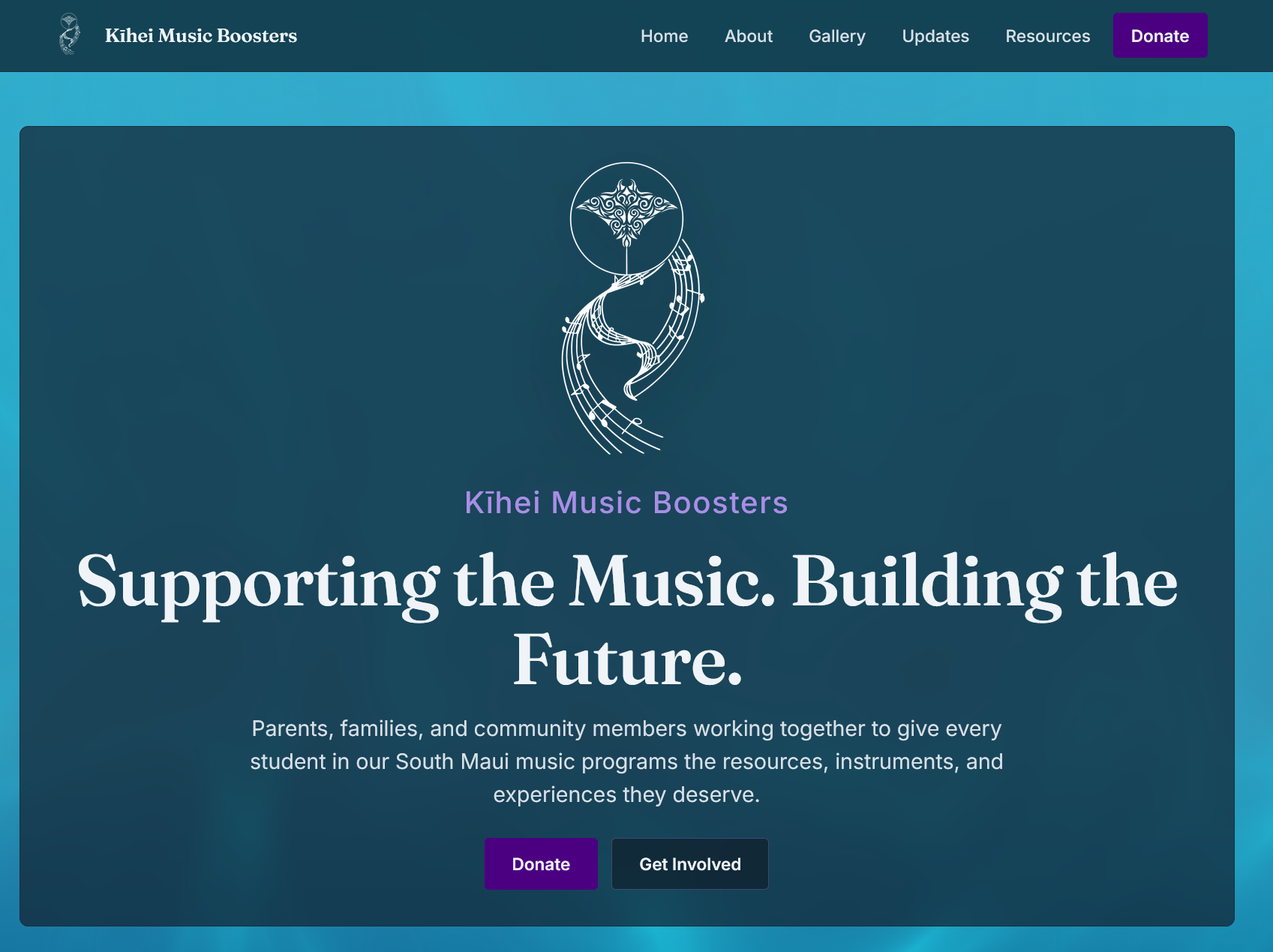
This past month, SeraphimGate Systems shipped a new website for the Kūlanihākoʻi Band Boosters — the parent-led 501(c)(3) nonprofit that supports the music program at Kūlanihākoʻi High School here in South Maui. The site is live at kiheimusicboosters.com, donations are flowing, and the cost to the boosters is exactly what it should be for a community nonprofit: zero dollars a year.
This is the story of how that came together, and why this kind of work matters to us.
Why We Took It On
The honest answer is that it's the right thing to do, but there's a fuller version of that answer worth sharing.
SeraphimGate Systems is based in Kihei. The boosters serve our neighbors' kids. The board is a group of parents giving their nights and weekends to keep instruments in hands, sheet music on stands, and uniforms on backs — covering the gaps that the school budget alone can't reach. They needed a real web presence: somewhere to accept donations, post the calendar of events, point people at the program, and look like the legitimate, serious nonprofit they are.
What they didn't need was a five-figure quote from a web agency, a monthly SaaS bill, or a "free" platform that would lock their content behind someone else's terms of service.
So we did what we do — but for free.
The Constraints (and Why They Made the Work Better)
Pro-bono engagements aren't just paid work without the invoice. They come with their own discipline:
- Cash cost target: $0/year. Every component had to run on a free tier or be donated. Cloudflare Pages, Google Workspace for Nonprofits, Google Calendar, Google Photos, PayPal nonprofit checkout — all free for 501(c)(3) organizations.
- Maintainability by non-SGS personnel. If a future board ever switches providers, the site shouldn't require arcane tribal knowledge to hand off. All copy lives in a single JSON file. Anyone with basic technical comfort can update a page.
- Brand and content authority stay with the board. We supplied structure, craft, and operational know-how. The board owns the message, the photos, and every final approval.
- No retainer, no ticket queue. Updates happen as a friendly favor, not a contractual obligation. The architecture had to support that — quick to update, slow to break.
Those constraints sharpened the work. There was no budget for cleverness, so every decision had to earn its place.
The Stack
| Layer | Tool | Why |
|---|---|---|
| Hosting | Cloudflare Pages (free tier) | Global edge CDN, free TLS, free preview deploys per pull request, auto-deploy on push to main |
| Generator | Python + Jinja2 | One JSON file → static HTML. No framework on top. |
| Content | A single pages.json file |
Source of truth for every page; non-developers can edit it |
| Calendar | Google Calendar (embedded) | Board-controlled; updates flow to the site automatically |
| Photos | Google Photos shared album | Same governance — leadership updates it without a developer in the loop |
| Donations | PayPal nonprofit checkout | Zero processing fee for 501(c)(3); board-chosen channel |
| Security headers | Cloudflare Pages _headers |
Full CSP, HSTS, X-Frame-Options, the works |
No server. No database. No Docker. No nginx. No .env file. Nothing for the board to patch, nothing that can be hacked, nothing that bills monthly. The build emits static HTML; Cloudflare serves it from the edge.
When the board sends new copy or a fresh batch of photos, we commit, push, and the site updates within seconds.
What's On the Site
Seven pages today:
- Home — hero with the music-manta mascot, intent funnel, what-we-do summary
- About — the org's mission, beneficiary program, governance
- Gallery — Google Photos album of performances and events
- Updates — embedded Google Calendar (Month view), event subscription link
- Resources — links for parents and students
- Donate — EIN, tax-deductibility info, mailing address, "give a check" instructions
- Fundraising — current campaigns and how to help
Two donation paths: the Donate button in the nav and support rail (PayPal, opens in a new tab), and the deep-info /donate.html page with mail-a-check details for donors who prefer that route.
A Few Pieces Worth Pointing At
The animated ocean background
Behind every page is an animated WebGL caustics canvas — the dappled light pattern you see at the bottom of a shallow ocean. It's hard-gated on prefers-reduced-motion, pauses when the tab is hidden, and DPR-capped so it doesn't melt phone batteries. It's a small thing, but it gives the site a sense of place — this is a Maui nonprofit, the design says so without needing to.
Logo as favicon
The board's existing manta-with-music-staff logo got cropped tight to the manta-in-a-circle medallion and rendered as a multi-size favicon.ico (16, 32, 48, 64, 128, 256) plus Apple-touch and Android-PWA variants. It's a small detail nobody notices when it's done right and immediately notices when it isn't.
Accessibility
Body text contrasts at 6.04:1 against the deepest substrate; link text at 7.19:1. Both exceed WCAG AA; the link contrast hits AAA. Accessibility on a nonprofit site isn't optional — your donors include people who need readable type.
The launch
The site was hidden behind a single under-construction page for one day, then revealed live at the joint parent meeting on the evening of May 22. The full site came back online during the meeting. We caught one nav-routing bug from a stale redirect rule that survived the restore commit (lesson filed: diff review is insufficient on restoration; preview-deploy verification of edge-config files is required), patched it the next morning, and the site has been clean ever since.
What This Means for Other Nonprofits
If you run a small nonprofit, a youth-sports league, a community-arts org, or a neighborhood association on Maui — and your current "web presence" is a Facebook page, a Squarespace draft from 2019, or a Wix site you're paying $20/month for — there is a better way.
The total cash cost of running a site like the boosters' is $0/year, plus your domain registration (~$12/year). Every other component is free for 501(c)(3) organizations. The technical bar to maintain it is "can edit a JSON file." And the result is a site that loads in under a second, scores well on Lighthouse, ranks for the things your community searches for, and gives donors a clean, trustworthy place to give.
If that sounds like your organization, reach out. We don't take on unlimited pro-bono work — our paying clients come first — but for the right local nonprofit, with the right scope, we'll make room.
The Bottom Line
Software is a force multiplier for the work nonprofits already do. The cost of standing one up correctly has collapsed to almost nothing. What's still expensive is judgment: knowing what to build, what to skip, what to refuse, and how to hand it off so it survives the next board transition.
That's the part we contributed to the Kūlanihākoʻi Band Boosters. The site is theirs now — every byte, every image, every word. We just made sure the foundation was solid enough to carry them for years.
🎺 If you'd like to support local music education on Maui directly, you can donate to the boosters at kiheimusicboosters.com.